Laissez-faire
See also:
Based on writings of late, we seem to have entered some kind of an era of non-consensual mathematics: mathematicians are suddenly publicly asking AI companies to stop doing mathematics with their unreleased models, and urging other mathematicians to stop collaborating with these companies. For example, an advisory group of senior mathematicians asked frontier labs “to stop testing advanced mathematical problems on proprietary models”1, and the newly founded Association for Human Mathematics urged “mathematicians to discontinue their work with OpenAI” and complained that “mathematicians did not ask for this work to be done”2. What I hear between the lines is, if you want to do mathematics with AI, ask first, or don’t do it.
I’m not saying it was aliens…but…
Take a hypothetical: Say aliens landed on Earth, much more advanced than us in various aspects, and it turned out they had discovered a similar set of axioms from which to derive mathematics. They bring us incredible results that we cannot comprehend, but which they can demonstrate to be true. (At least) I think we would have been both baffled and over the edge with joy at being handed “keys to the universe from the heavens”. But now, when AI does something like this, it’s suddenly wrong3.
This brings to my mind a quote from Richard Feynman, whom I like to quote in many instances: “We are very lucky to live in an age in which we are still making discoveries.” He was referring to physics, and he saw the age of discoveries ending in one of two possible ways: either all the laws become known, or the experiments get harder and more expensive, until progress becomes slow and uninteresting.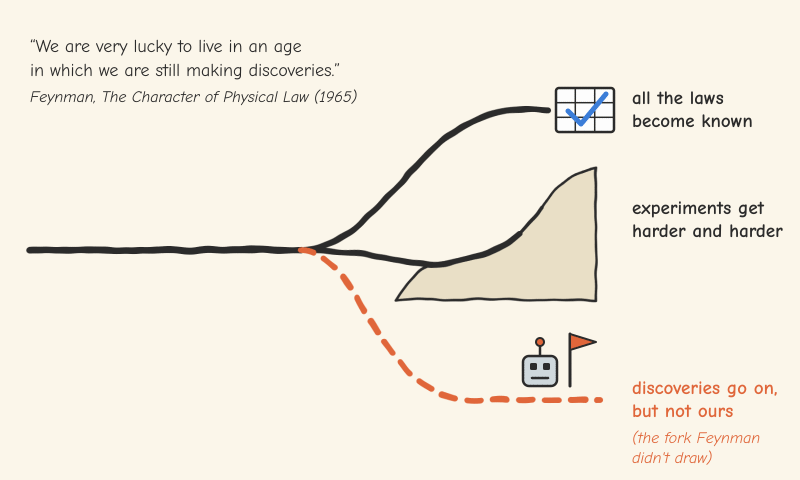
But there was a third way to fail the condition of making discoveries (perhaps even others we still don’t see), which Feynman didn’t consider, and most of us didn’t either, because it was accepted it would always be we who make discoveries. But now that “we” is no longer only human, people are angry. It was never given that only people would be doing science and making discoveries, we just didn’t have to calibrate ourselves to it.
Good grief
I am quite surprised by the strength of the counterreaction, since such a reaction seems needlessly human-centric. We, the people, don’t own scientific results, nobody does. This was set out a long time ago by Robert Merton in his four scientific norms going by the acronym CUDOS, standing for Communism (later also Communalism), Universalism, Disinterestedness, and Organized Skepticism4. It is true these requirements and their precise forms were conceived during a much simpler time, but their message has gone nowhere: In particular, some takes in the current discussion lack in at least the first three, while the fourth takes a hit if AI-driven results are not properly checked. To me an “only we can do this, we own this”-mentality is a kind of an antithesis of the norms of Communalism and Disinterestedness. To be fair, the advisory group’s complaint is itself a Mertonian one: results from models nobody else can use are hard to call communal, or to scrutinise.
What also comes to mind are the five stages of grief: denial, anger, bargaining, depression and acceptance. Many grief researchers reject this as a literal description of how people actually grieve5, but I feel it is rather a loose taxonomy for different categories of coping mechanisms6. Since OpenAI’s Lean-checked blowup for the forced Navier–Stokes equations and its drop of over 700 AI-written manuscripts on 6 October78, much of the community has been on edge, and to me a good part of it still looks to be in denial that mathematics has changed for good. Some are infuriated by the transformation, while some are starting to bargain for a better deal by asking the labs to stop testing problems on models nobody else can use while trying to search for the role that humans are still to occupy.
A concrete example of this comes from The Association for Human Mathematics, which states its mission as protecting “mathematics as a human endeavor against the threat of artificial intelligence”9 (emphasis mine). To me this sounds more like an association for anti-AI mathematics. I find such a cause commendable, but I don’t believe the thesis: The genie is out of the bottle, and it ain’t going back. We need to re-incentivize academic exploration to be centered around understanding, not stop the proof generation with new methods.
Bargaining
Something I thought I would never see is a thought experiment in the slides of “Math 2.0”, a public lecture Terence Tao gave at Caltech on 9 October10. In it, AI is asked to find a cure for cancer that passes a stage 3 clinical trial. It produces a cocktail of previously unknown chemicals; nobody truly knows how it was found, but it comes with a “Lean certificate” for its prediction, and it passes the trial. Tao turns to you: you have just been diagnosed with early-stage cancer, and a chatbot recommends this treatment. “Before injecting this cocktail into your bloodstream, would you find it reassuring to know that there is at least one human cancer expert who understands – even partially – the mechanism behind this cure? Or a human mathematician who understands the mathematical model used to locate and analyze the cocktail?”
Even if Tao didn’t mean the example to come out this way, it sounds like a strawman: Obviously it would be reassuring, but nearly every patient would take the cure anyway. Medicine has always accepted cures because they demonstrably work, without knowing why. An oncologist, Vinay Prasad, made exactly this point the day after the lecture: “there’s not a single cancer patient on Earth who would say no thank you. We currently accept far less.”11
The true question behind the rhetorical one is of course a normative statement about how mathematics should be done, according to human-centric mathematicians. Surely, understanding would reassure us against a misaligned cure, but science has caught the “lead cases” with trials and further research, not by waiting for a mechanism to appear or sticking to old paradigms.
Such an analogy also feeds those who are willing to shift the goalposts for anything AI does: “AI is fine, but it cannot cure cancer”…and when it some day will (Anthropic has just set up a wet lab, with the aims of letting AI direct the experiments and of finding treatments for rare diseases12), just ask it to bring you the moon. Checkmate, AItheists!
I don’t want to trash Tao here though; after all, he has gone further with AI tools than most mathematicians, even co-authoring a paper that turned DeepMind’s AlphaEvolve loose on 67 problems13. I do agree with the conclusion he draws, that we should strengthen the ways in which human understanding interacts with mathematics. I guess his feelings towards mathematics are, like those of many, still convoluted: Many of us are still far from accepting that the playing field has fundamentally changed, let alone from finding a new, calibrated identity. But it doesn’t change the fact that mathematics has changed, and it will not change back.
Moving on
It might be the fate of humans to start understanding and digesting the results proposed by AI, and the sooner we get to the stage of acceptance, the sooner we can start doing that, and more importantly, finding new ways of doing mathematics in a balanced way. I expect this will hit other sciences as well, especially the more mathematical ones like string theory or theoretical physics in general. As a theoretical physicist, I don’t feel scared yet in the same way though: I already work mostly with AI, to a large extent verifying AI results, but at the same time I’m building my own understanding. Of course, I might just be lucky. Even if, it doesn’t hurt my ego to derive results with AI, since I can still understand the world, deepen my field and benefit society, doing things I like. Simply put, I am still having fun.
I guess I cannot see why mathematicians couldn’t also still have fun. Josh Frisch wrote that after 6 October he is “trying to move beyond loss”, and that “if we can learn the answer to our one question, even if the proof did not come from us, even if it did not come from any human being, then we need to try to understand it and to share that understanding with each other.”14 Martin Bridson on the other hand names the fear, a mathematician “reduced entirely to explaining the output of others (humans or machines)”. That is by all means a valid fear, but such becoming reality as a “bad ending” also requires that we never update our academic reward mechanisms, and I’d like to think we are starting to.
Science was always marketed to the world and funding bodies with the high goals of understanding the world and of benefiting society, but this autumn showed that for many of us it was also, even mainly, about the human doing the understanding. Thurston said this explicitly already in 199415, so it was never a secret, but it still sits uneasily with Merton’s norms. I feel sad for the pain I see my colleagues going through (in math, and otherwise). I believe that in the end those pains are useful mostly for the purposes of mourning, while real solutions can be found only as we accept the phase shift and start building anew with fresh ideas.
Advisory Group on Mathematics and Artificial Intelligence, “Responsible Release of AI-Generated Mathematics” (29 September 2026), https://agmai.org/general-sep29/. ↩︎
Association for Human Mathematics, Communications Working Group, “AHM Statement on OpenAI’s October 6 Release of Mathematical Documents” (7 October 2026), https://www.ahmath.org/statements. ↩︎
Ted Chiang imagined a version of this in Nature already in 2000, with genetically enhanced “metahumans” in place of the aliens, and human scientists turning to “hermeneutics: interpreting the scientific work of metahumans” (T. Chiang, “Catching crumbs from the table”, Nature 405, 517 (2000), doi:10.1038/35014679). ↩︎
R. K. Merton, “A Note on Science and Democracy”, Journal of Legal and Political Sociology 1, 115–126 (1942); reprinted as “The Normative Structure of Science” in The Sociology of Science (University of Chicago Press, 1973). ↩︎
M. Stroebe, H. Schut and K. Boerner, “Cautioning health-care professionals: bereaved persons are misguided through the stages of grief”, Omega – Journal of Death and Dying 74(4), 455–473 (2017), doi:10.1177/0030222817691870. ↩︎
K. Buzzard, “To grieve, or not to grieve?”, Xena Project blog (1 October 2026), https://xenaproject.wordpress.com/2026/10/01/to-grieve-or-not-to-grieve/. ↩︎
OpenAI, Lean certificates accompanying the Navier–Stokes and Euler results (8 September 2026), https://github.com/openai/NavierStokesAndEuler. ↩︎
OpenAI, mathematical manuscripts and Lean formalizations (released 6 October 2026, changelog 7 October 2026), https://github.com/openai/math. ↩︎
Association for Human Mathematics, https://www.ahmath.org/; membership commitments, https://www.ahmath.org/members. ↩︎
T. Tao, “Math 2.0”, public lecture, AIM Public Lecture Series, Caltech (9 October 2026), slides https://teorth.github.io/tao-web/slides/math-2-0-caltech-2026.pdf; T. Tao, “Math 2.0”, What’s new (10 October 2026), https://terrytao.wordpress.com/2026/10/10/math-2-0/. ↩︎
V. Prasad, “Terrence Tao does not understand cancer medicine”, Substack (10 October 2026), https://www.drvinayprasad.com/p/terrence-tao-does-not-understand. ↩︎
J. Dastin and M. Erman, “Anthropic quietly sets up biology lab as it ramps AI drug program”, Reuters (18 September 2026), https://www.reuters.com/world/anthropic-quietly-sets-up-biology-lab-it-ramps-ai-drug-program-2026-09-18/. ↩︎
B. Georgiev, J. Gómez-Serrano, T. Tao and A. Z. Wagner, “Mathematical exploration and discovery at scale”, arXiv:2511.02864 (2025). ↩︎
“100+ reactions to 100+ solutions”, Proofs and Prompts (8 October 2026, updated 11 October 2026), https://proofsandprompts.com/2026/10/08/100-reactions-to-100-solutions/ (accessed 13 October 2026). ↩︎
W. P. Thurston, “On proof and progress in mathematics”, Bulletin of the AMS 30(2), 161–177 (1994), https://arxiv.org/abs/math/9404236. ↩︎
Comments
Comments run on GitHub Discussions, so you need a GitHub account to post.