ζ₃(5) is irrational...maybe.
What is a theorem worth to its ‘author’?
See also the previous posts:
It is a melancholy experience for a professional mathematician to find himself writing about mathematics. — G. H. Hardy, A Mathematician’s Apology1
(And for the record, I cannot be considered even a mathematician, let alone a professional.)
The title is the subject: the 3-adic zeta value ζ₃(5) is irrational, but only maybe. The notes that claim it are attached to this post, and they were written by AI agents that I set loose a week ago on a topic I originally knew next to nothing about (now I know “previous to something” about it). What follows is a case study of my own experience with that, of understanding and of the meaninglessness of a mathematical proof from a human-centric point of view; in short, of the senselessness of it all.
The title is not the theme though: that is wording our nuanced, fundamentally human feelings when in a transition such as this, and about striving to understand the complex motivations leading to the production of these kinds of works.
Before I recall the timeline, let me state something clearly. I don’t consider this work, or this post, to be a scientific publication in any sense of the word, and you shouldn’t read it as one. If it was, these notes would be on arXiv as a preprint. I could not present the proof, or the presumed proof, in a scientific manner, in a seminar or at a conference, since I can barely describe the concepts and method it uses. I have read through it, checked that all references parse, and tried to understand what is going on, and the best I can say is that the claim seems plausible, and I think it is worth putting out as a note for someone interested. In what follows I will implicitly assume that the proof is correct. It of course might not be since I cannot confirm it, but I cannot deny it either, and for the case study here, it makes little difference.
Nights at the office
Around a week ago, at an event with friends, I ended up talking with a real mathematician, who told me about a preprint by A. Fauzan proving that ζ(5) is irrational. Apparently it has held up so far2. This could be a big deal, since the Riemann zeta function, , is understood at even integers since Euler (), but at odd integers the only single value known to be irrational was ζ(3), by Apéry in 19783. In fact, two-point (previously one-point) physicist induction says, that the zeta should be irrational for every positive odd integer value above 1. Each prime p also has its own p-adic version ζₚ(s), living in the p-adic numbers, where two numbers are close when their difference is divisible by a high power of p, and a few of those values have been proved irrational as well4.
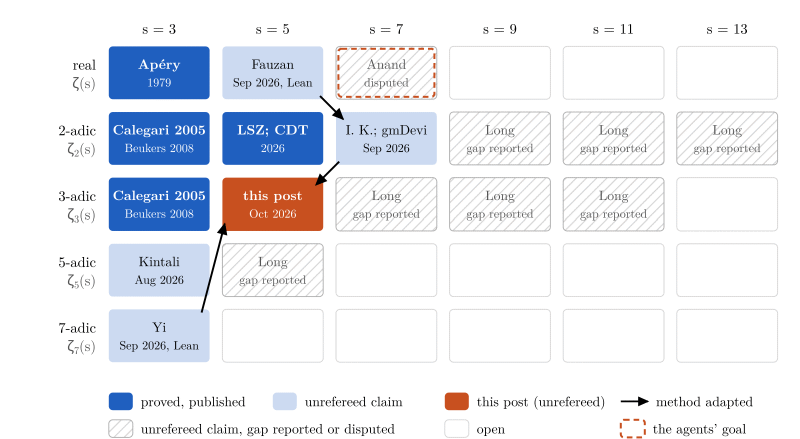
I thought that Fauzan’s proof had likely been obtained with help from AI, while Frank Calegari wrote in his blog that the paper gave him “the impression of being almost entirely AI generated”5 (not to say this to Fauzan’s detriment in any sense; we are deconstructing, not moralizing here). I have my own AI research workflow, and I happened to have at that point a large amount of usage completely unused. So I thought, what about ζ(7)? Let’s just deploy an agent army of my own, using the new Opus 5.5 model (which, compared to Fable, burns next to nothing) and my research loop workflows, and see if the agents can find something.
I had very little understanding of the topic: I have taken a course on modular forms, I’m a theoretical physicist, aaaand…that’s it. Since then I have compiled, using AI, a lecture note of several hundred pages with exercises, in case I want to study the topic on my own at some point. Funny enough, I also asked Claude to make me a dumbed-down version of the paper for myself to read, so that the process I have gone through could become an actual learning experience and perhaps help me graduate at some point also from mathematics.
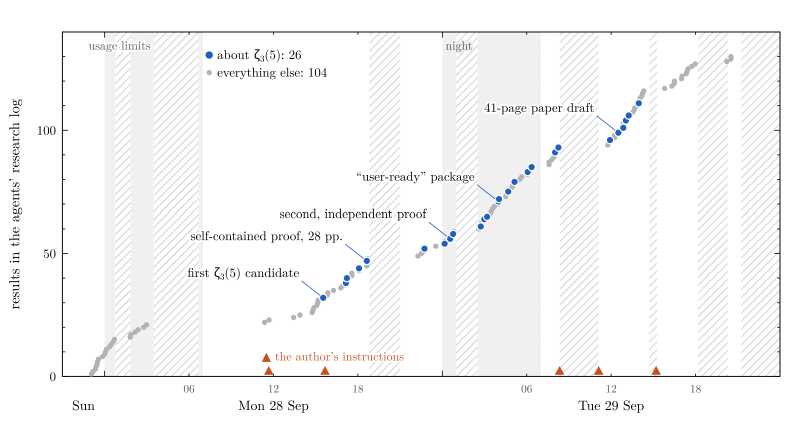
Two days went by, and on Monday I came to my office to see what had happened during the night. Claude Code had a message for me: the agents could not find ζ(7). If ζ(7) were a fraction a/b, the denominator b would need more than 5000 digits, so numerically it is most likely irrational, but that’s no proof. We had been discussing other cases with various long-shot ideas: What about ζ(9), since 9 is the first odd composite and ζ(3) is known to be irrational? Or ζ(15), since 15 combines two different primes, both now known to give an irrational zeta; maybe there is a difference between these two composite cases. What about bootstrapping more irrational values with the two existing results? Or the p-adic variants, ζₚ(p) such as the 5-adic ζ₅(5), or some p-adic value of ζ(7)? I said these to Claude, Claude clarified them and said, okay, let’s deploy an agent army, try all the arguments there are in the literature and see if any of this makes sense. And, lo and behold, the next morning I had a message, and a “paper”: a set of notes telling me that yes, the 3-adic value of ζ(5) is irrational.
After an extensive web search, Claude told me it could not find a proof of this, and when I had it check again a couple of days ago, it still could not. The one claim I have heard of, an unrefereed manuscript listing twenty-two p-adic zeta values, has a possible gap reported by a reader in its repository6, so I guess there is a non-zero chance that these notes contain the first proof. There could exist one I’m not aware of, and if there is, that’s very cool (even cooler, if the proof is not incomprehensible)! Either way, this probably does not count as the proof even if correct, since I am not publishing it as a scientific work. Over six days the project gathered 226 commits and a research log of some three thousand lines, a good part of it written at night.
Who am I gonna call?
For five days I’ve been thinking what the hell should I do with this result. It is an obvious case in point of how mathematics is refactoring itself, and a prime example of what David Bessis calls the Overhang7, results that only need someone to connect dots already present in the literature. If I understand correctly, Claude has taken frameworks from other works and shown that a similar estimate, done before for other zeta values, also works for ζ₃(5): the notes adapt to p = 3 a recent 2-adic argument8, which itself was built on Fauzan’s ζ(5). The rough shape is the “classical” one: if ζ₃(5) were a fraction, one could build from it a nonzero integer, divisible by a higher power of 3 than its size allows. The ingredients for estimating the two sides come from all over: Volkenborn integrals (a way of integrating over the 3-adic integers), Hankel determinants, Wilson’s theorem from elementary number theory and, in a second, independent proof, overconvergent modular forms. Looking at this alchemistic mixture, I am very surprised how the things put together manage to show this.
I’m not going to be good enough, in a short enough time, to publish this as a real paper. So why publish it here at all? Because Claude claims it has proved the result three ways, two of which are somehow dependent and one of which is independent of the two, based on modular forms. The notes contain the main proof and, as an appendix, the independent one, adapted from an argument for ζ₇(3)9. Even if I cannot comprehend the proof myself, a very capable large language model (I can’t really define intelligence for these machines) tells me it has performed all the numerical checks, has proved the claim along routes that both hold, has used the previous literature, and that everything matches. That gives me a strong reason to believe that at least most of it is correct knowing how generally capable modern models are in doing actual science.
In the first post of this series I asked who you gonna call when you don’t understand. Here no human expert has checked the proof, and the only one I can call is the model that wrote it. The statement on the use of AI in the notes says as much: the checks were done by other instances of the same models, and “such checks may share the blind spots of the models that wrote the proof”.
Because of this balance of things, here is the file:
On the irrationality of the 3-adic zeta value ζ₃(5) (PDF, 49 pages), also deposited on Hexagon
I have read through it and had various parts rewritten which I could comprehend AND found unclear. If you want to turn this incredible mixture of arguments into something more readable, go ahead, but I doubt I am going to be the one to do it. I share it because otherwise I would just be saying that ζ₃(5) is irrational, and I could not talk about this case study at all.
As I said, I have also asked for a dumbed-down or expanded version of the paper, where every statement is derived from first principles, and the first principles themselves are shown with examples. That workbook is below:
A companion to the note (PDF, 269 pages)
Note: I have not checked through this file at all except scrolled through, and have only asked Claude to double check every reference so that they would be as correct as machinely possible. I have not seen LLMs hallucinate references for quite some time now, and I am willing to believe they are pretty much correct, at least approximately as correct as an average human would be. However, due to these caveats, I want to stress that I take no responsibility of the correctness of the contents of the above file and do not posit it as any kind of scientific work, even though my belief in modern AI is strong enough to believe, that almost all of the contents are correct, and that for anyone trying to understand the proof, the contents are also highly valuable.
Set for life
I’m doing a PhD in theoretical physics, and I’m also a math master’s student, who might or might not graduate. If, before the age of mass AI, I had managed to cook up this kind of an elaborate proof on such an arcane topic, I would have considered it to be some kind of a golden ticket for academia: into a postdoc, maybe another, leverage those into a tenure track, whatever. Maybe not, but in my mind it could have been one, at least when used correctly.
What is its value now? Currently, it’s worth next to nothing, except that it has given me a reason to write this post. In the previous post I wrote that proofs lose their value as a currency once they stop being scarce, of which, again, this is a prime example10. That’s not much, considering that the result in itself is, I think, amazing. It seems like a deep connection, and the connections between the fields used for the proof are amazing. But at the same time, I feel nothing, because I did nothing. I have no vested interest in this topic. I haven’t worked on it for years; “I” have been “doing” it for a week.
I do feel that finding these kinds of results with AI is still exhilarating, since it also acts as a training ground for me to look deeper into a topic, even if there is no reason to believe I would ever publish the results in a journal. For years I have been interested in the Riemann zeta function in its various forms, because it shows up in many places also in theoretical physics. But I can’t say I ever had an interest in truly proving claims like this. Let’s be honest though: everybody’s occasionally power-tripping about finding some magical proof of the Riemann hypothesis, but let’s not go there. Realistically, I had no intention of doing a proof like this, and because I don’t have my skin in the game, cooking one up doesn’t evoke anything deeper in me than “wow, that’s cool”. It doesn’t matter. I’m not more of a mathematician than I was before, and I’m not more capable of producing these kinds of arguments.
And when I say I don’t understand the proof thoroughly, it’s not just that I don’t understand it: I don’t really even care to understand it deeply. That is the biggest problem here: if I did care, eventually I would understand it, or I would have already, had I cooked up the proof myself. Feynman’s “What I cannot create, I do not understand” never guaranteed the converse, and here we are: “I created”, so to speak, and the creating didn’t even make me want to understand. The balance is so off that it’s senseless, and it’s the senselessness of it all that makes it feel so weird.
When Apéry presented his ζ(3) proof in 1978, it was met with disbelief, but people still cared enough to work through it. For my notes I don’t see who would, me included. So here we have a problem I had no interest in a week ago, that I, in multiple quotes, may have managed to solve, and which means next to nothing to me currently. The only meaning is that I think it’s cool, because I love deep connections we cannot yet understand, both in mathematics and in how they apply to theoretical physics.
Give it a go?
So I don’t really know what to think. This is just my personal case study, but I think that in adjusting our identities to the age of mass AI it is mandatory to talk about our feelings: to find words for the disconnect from our own fields (science, or anything else really), for the gut feeling that something is not right. I believe most of these feelings stem from the human-centric view of science and the world, which also may have to give way to a future in which automated, LLM-driven laboratories do anything. We need to strip away the ego, expose all implicit assumptions, deconstruct the social structure that we have always relied upon, and get to the bottom of the feeling of something being wrong. Perhaps even these kinds of proofs are valuable, and we just haven’t found out why. Should someone set up arXAIv.org? (I checked: both arxaiv.com and .org have been taken already. Big things coming?)
I have to add something here: I feel the problem has started to grow on me as I have written this blog post and tried to confirm the result. The feeling of indifference is becoming nuanced: even though I still feel the work is not mine, I am starting to feel some interest through doing it myself, through exploring the topic and building my own understanding on it. I have even started to reconsider if I should give some real time like a week to studying in-depth and seeing if I get something out of it. Perhaps this is driven by some selfish, extrinsically valued interest in doing the proof as a stake for the future; perhaps the problem just itself is interesting to me; or something else I cannot describe.
In fact, this kind of AI-driven math research might even become a certain kind of a hobby, where at the end of the week I start my research loops with leftover usage and leave Claude running for the weekend to see if anything pops out. Not having my skin in the game allows me to keep this more fun and less serious. Perhaps I’ll even keep posting these kinds of interesting zeta results if any others pop up.
Finally, if, for some reason, somebody reading this really wants to take a jab at understanding this proof, at verifying whether it’s correct, formalizing it in Lean or whatever, go ahead. I’d be extremely happy if somebody did; I’m “preliminarily interested” to know if this is actually correct. Which goes to show, again, that I don’t know. Maybe.
G. H. Hardy, A Mathematician’s Apology (Cambridge University Press, 1940; reissued with a foreword by C. P. Snow, 2012), doi:10.1017/CBO9781107295599. ↩︎
A. Fauzan, “ζ(5) is irrational”, preprint (17 September 2026), Zenodo, doi:10.5281/zenodo.22826419. Lean formalizations, for example https://github.com/mo271/Zeta5 and https://github.com/danromik/zeta5-irrationality. ↩︎
R. Apéry, “Irrationalité de ζ(2) et ζ(3)”, Astérisque 61, 11–13 (1979). ↩︎
F. Calegari, “Irrationality of certain p-adic periods for small p”, International Mathematics Research Notices 2005(20), 1235–1249, doi:10.1155/IMRN.2005.1235; F. Calegari, V. Dimitrov and Y. Tang, “Arithmetic holonomy bounds and effective Diophantine approximation”, Proceedings of the International Congress of Mathematicians 2026, Vol. 3, 356–376 (SIAM, 2026), doi:10.1137/25M1806776, arXiv:2510.04156; L. Lai, J. Sprang and W. Zudilin, “A note on the irrationality of ζ₂(5)”, International Mathematics Research Notices 2026(16), rnag180, doi:10.1093/imrn/rnag180. ↩︎
F. Calegari, “zeta(5) is irrational”, blog post (24 September 2026), https://galoisrepresentations.org/2026/09/24/zeta5-is-irrational/. ↩︎
C. D. Long, “Hybrid arithmetic holonomy and twenty-two individual p-adic zeta values”, manuscript (24 August 2026), https://github.com/octonion/p-adic-zeta-irrationality. ↩︎
D. Bessis, “The fall of the theorem economy: How AI could destroy mathematics and barely touch it”, Substack (21 April 2026), https://davidbessis.substack.com/p/the-fall-of-the-theorem-economy. ↩︎
I. K., “ζ₂(7) is irrational via Hankel determinants”, preprint (2026), Zenodo, doi:10.5281/zenodo.22961248. ↩︎
T. Yi, “A determinant argument for the irrationality of ζ₇(3)”, manuscript (15 September 2026), https://github.com/TaifengYi/zeta7-irrationality. ↩︎
I want to also casually mention that as a side result along the way, the agents found various bounds on the windows of irrational zeta-values like that at least one of ζ(7), ζ(9),…, ζ(21) is irrational. This claim was posted publicly by two other people about a day after, so the zeta-mania seems to be still going strong11. However, there are possible others found today, that I have not seen posted elsewhere. If I continue with this hobby, I might keep adding other cool new (possible) results in some continuation posts. ↩︎
https://github.com/gmDevi/zeta-7-21-lean; https://github.com/CoolRmal/odd-zeta-irrationality. ↩︎
Comments
Comments run on GitHub Discussions, so you need a GitHub account to post.